📄 Digital book in PDF · read it on your phone or print it
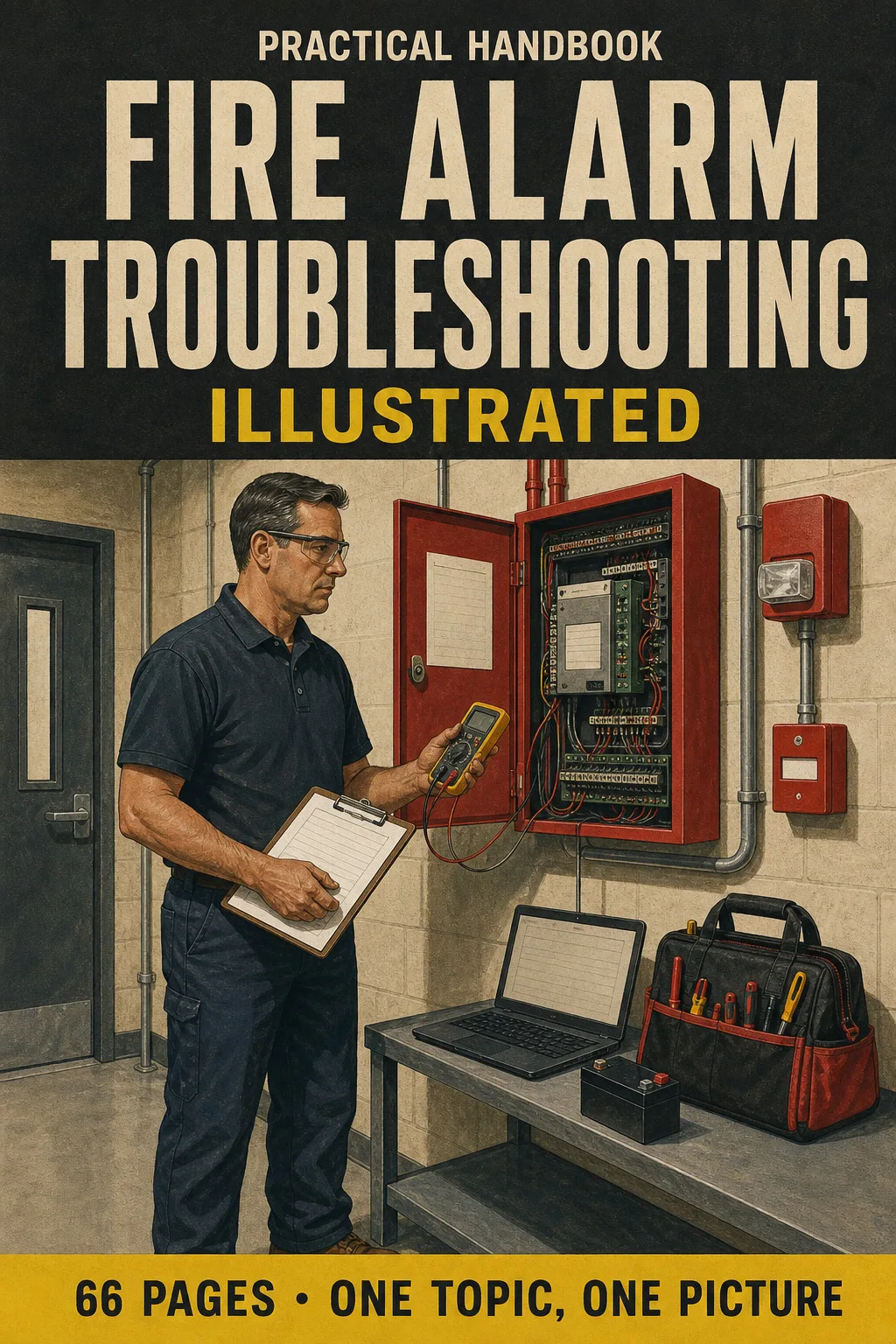
Panel signals, Class A and Class B circuits, meter setup, half-splitting, ground faults, opens and shorts, NAC polarity, addressable loops and battery math. Every topic gets its own page: the drawing first, then what you need to remember. 66 illustrated pages.
🔒 Secure checkout · PDF by email · 30-day guarantee
Every page has one big drawing and a box with the readings and steps you need to know:


Swipe to see more →
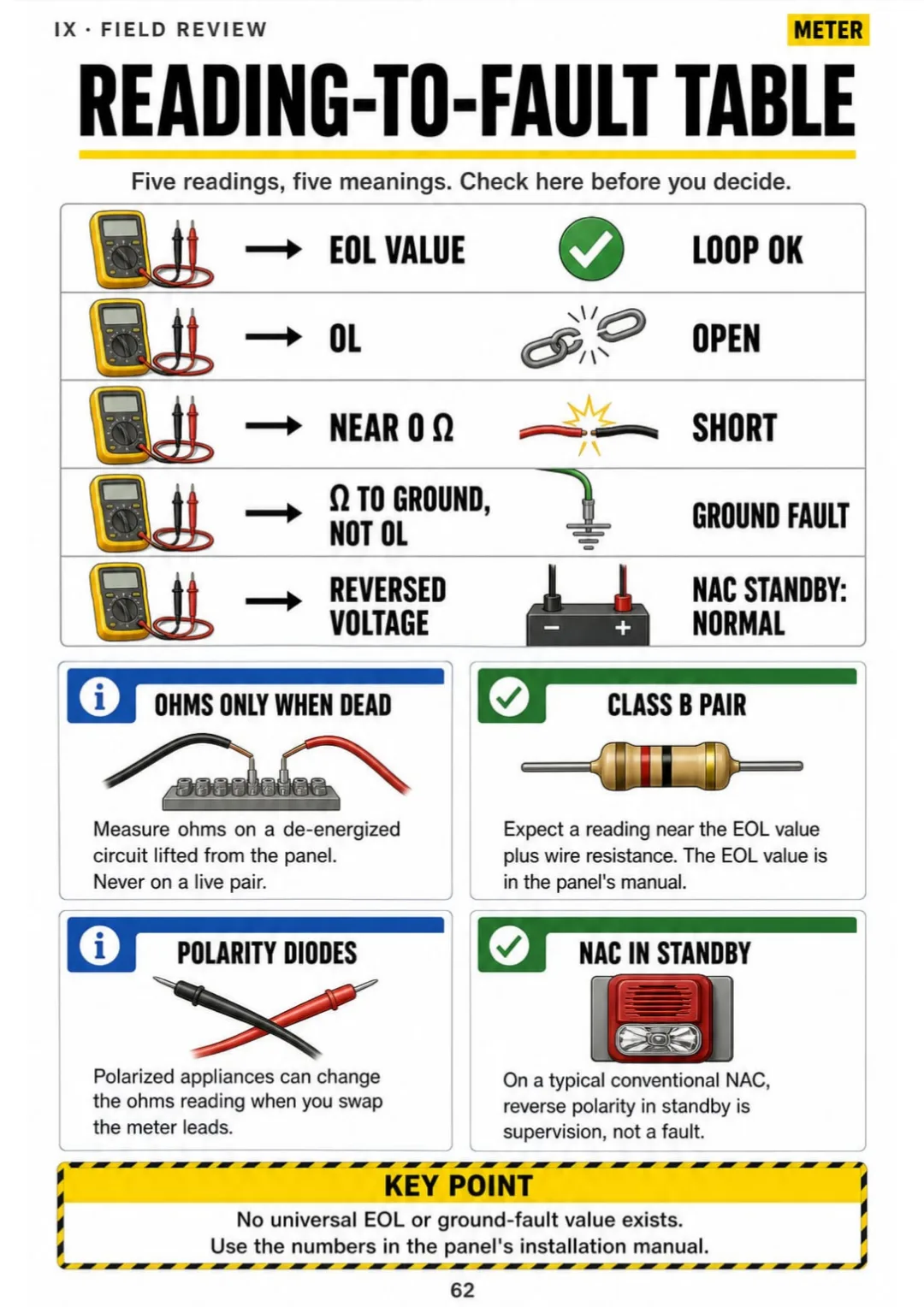
These are real pages from the book. The table of contents is the full one: 9 parts and 62 topics.
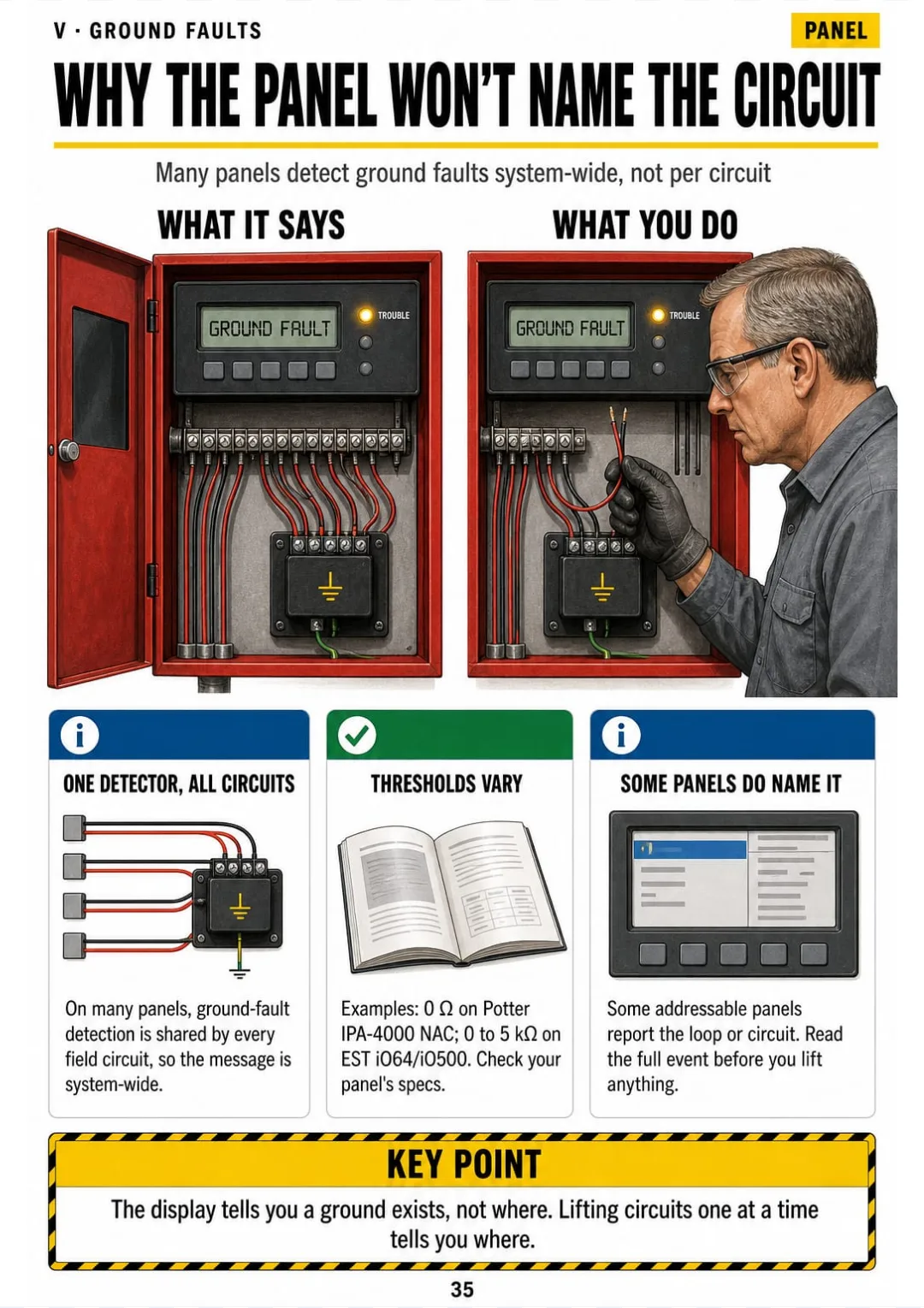
You're standing at a panel that reads GROUND FAULT. It clears, comes back an hour later, and the building manager is watching you lift wires.
You know your meter. What's missing is the order. The manual covers ground faults in paragraphs of theory, and none of them tells you which leg to measure or what the number means.

In this book it's one page: the circuit drawn with the wires lifted at the panel and the meter on each leg to ground. + reads 22.7 kΩ, − reads 18 kΩ: the lower leg is the grounded one. From there, you half-split.
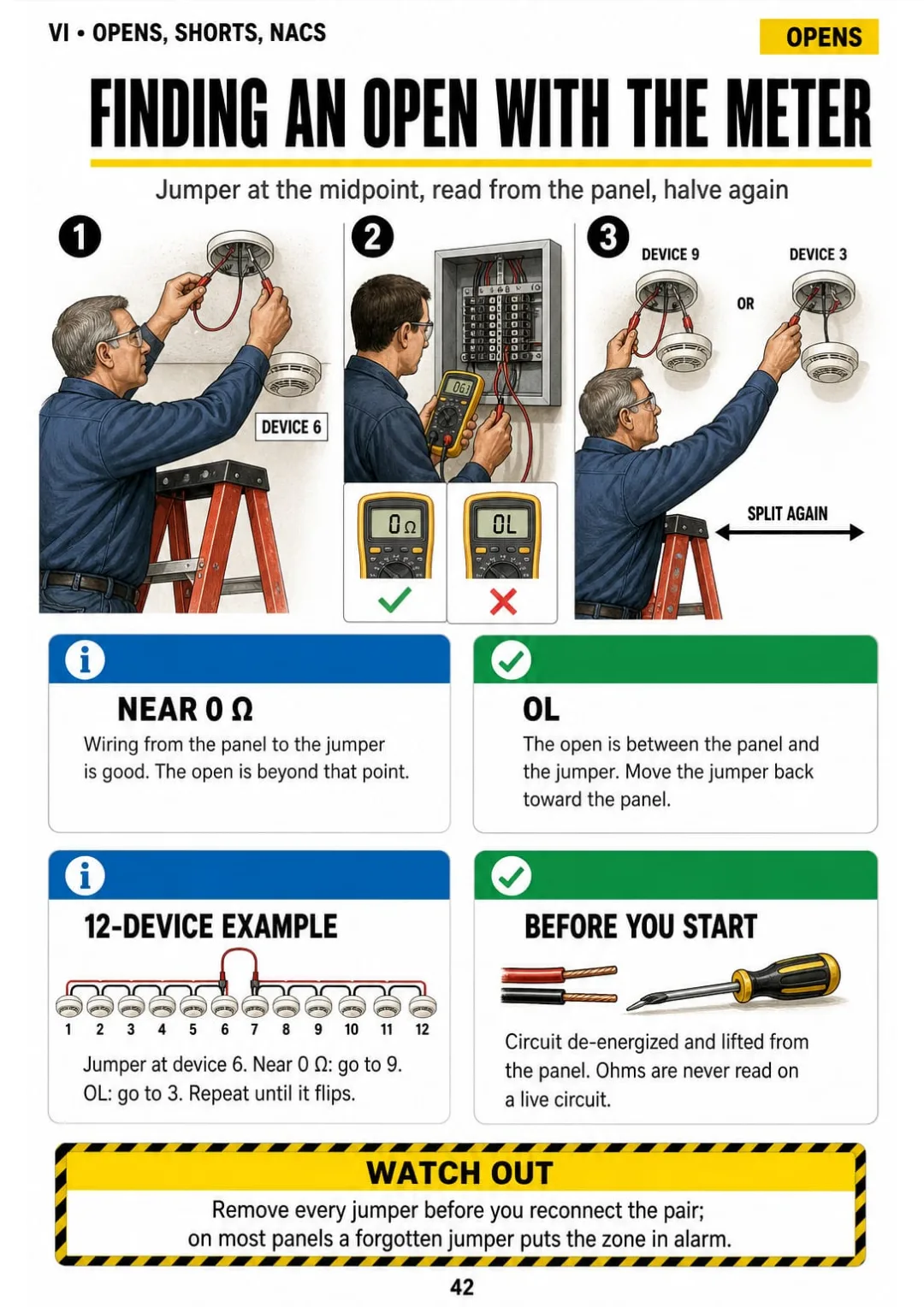
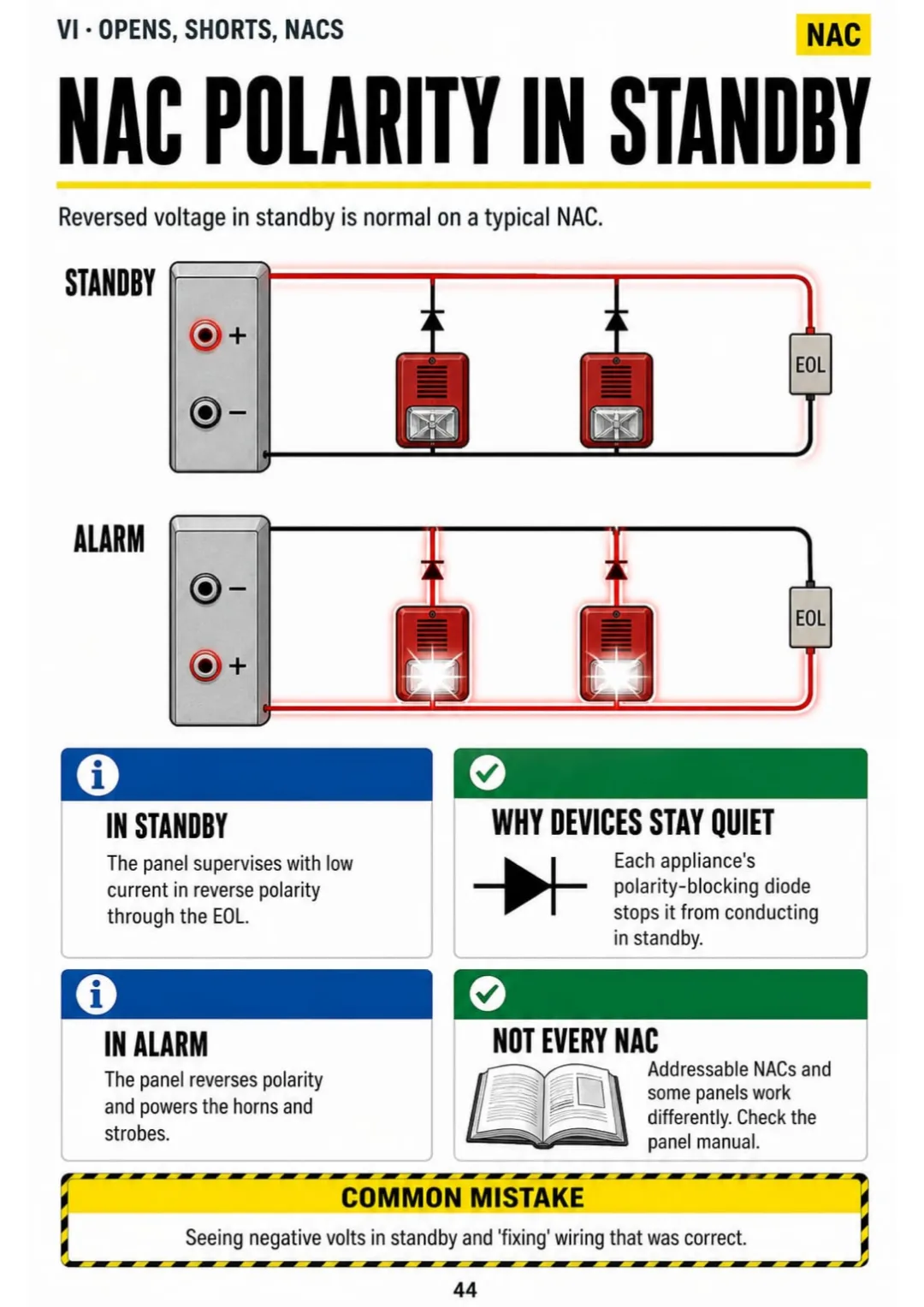
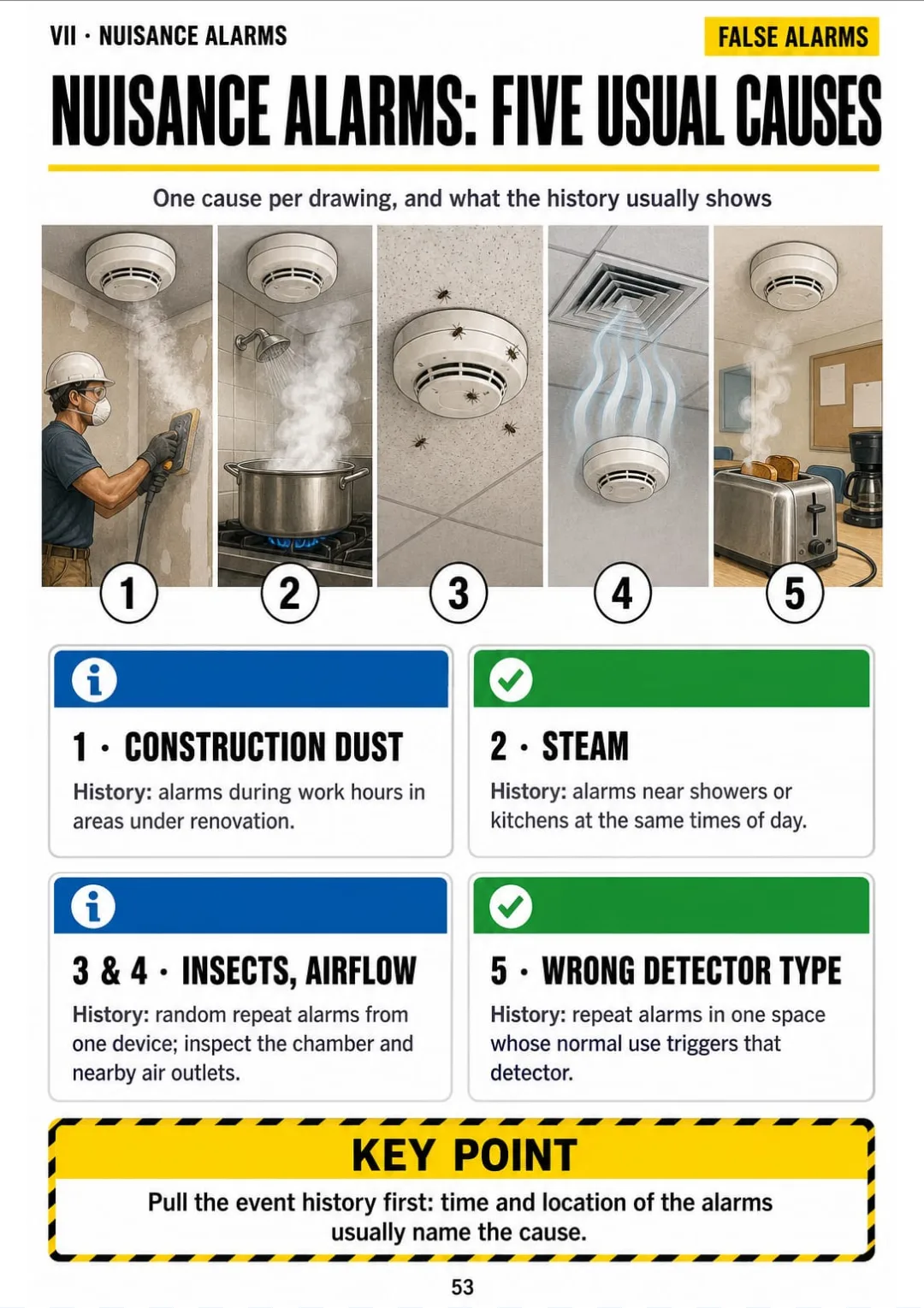
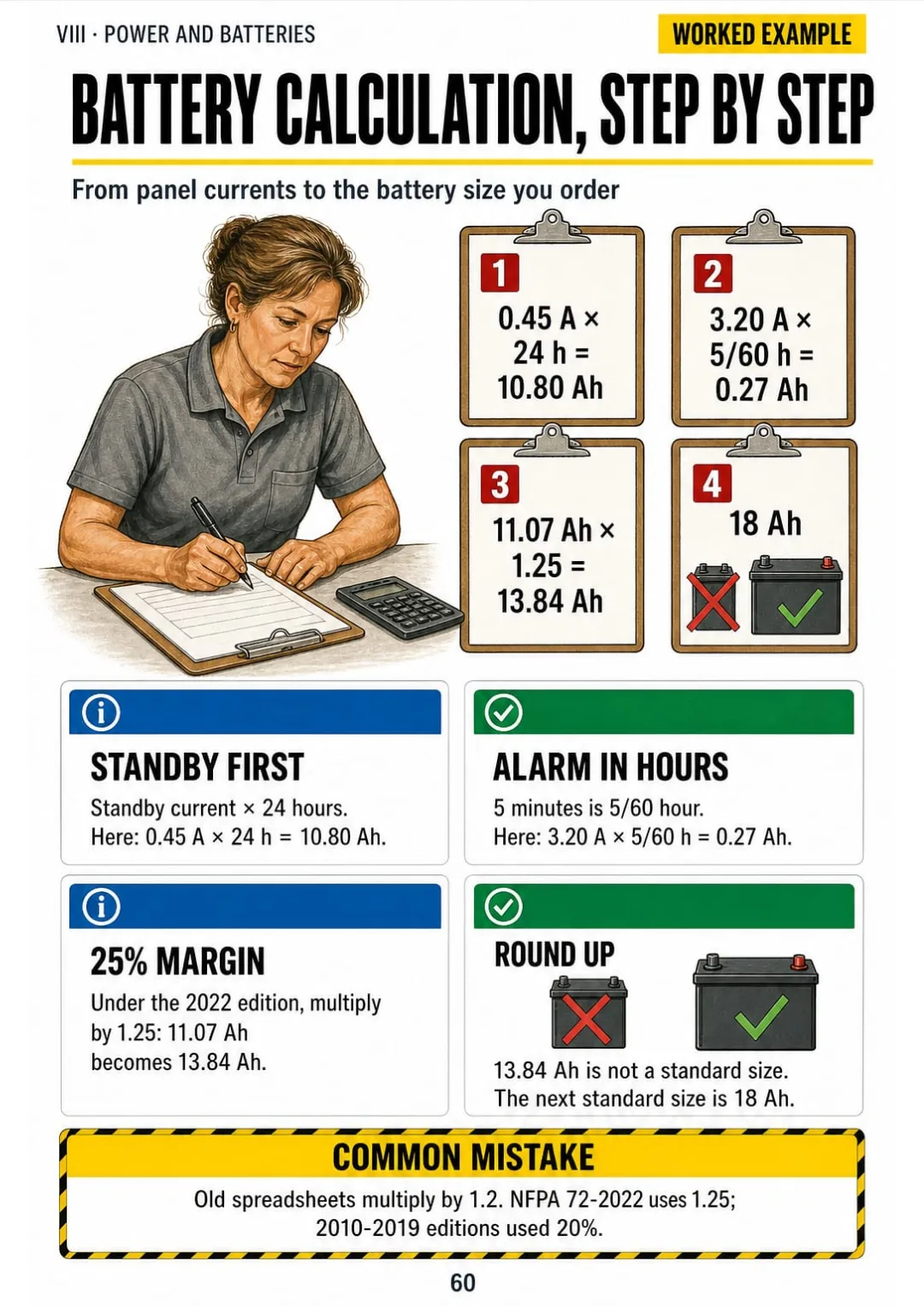
The rest works the same way: an open found with a jumper at the midpoint, NAC polarity in standby, the five usual nuisance alarm causes, battery math in amp-hours. Each one on its own page.
Next call, you measure, you read the number and you know which side to go after, without the manual open on the floor.

Reading the panel, the system as a block diagram, safe work and meter setup, the seven-step order, ground faults, opens, shorts and NAC faults, addressable loops and nuisance alarms, power and batteries, and a field review: 66 pages, all illustrated.
Think of it this way:
It's a Tuesday service call. The trouble LED is on, the display says NAC TROUBLE, and you need to know if it's the field wiring or the board before you lift a single wire.
You open the book to the NAC page and see the circuit drawn: polarity reversed in standby, flipped in alarm, and exactly where your meter leads go.

Same with a ground fault, an open on a Class B IDC, a short on an SLC, a nuisance alarm that keeps coming back and a battery calculation: each one on its own page.
Fire Alarm Troubleshooting Illustrated is 9 parts and 62 topics, all drawn, and it ends with a reading-to-fault table and a seven-step checklist to print.
What you see drawn, you don't have to memorize.
Alarm, supervisory and trouble side by side, the trouble LED, display messages, what each button does, the event history, latching faults and your first-look checklist.
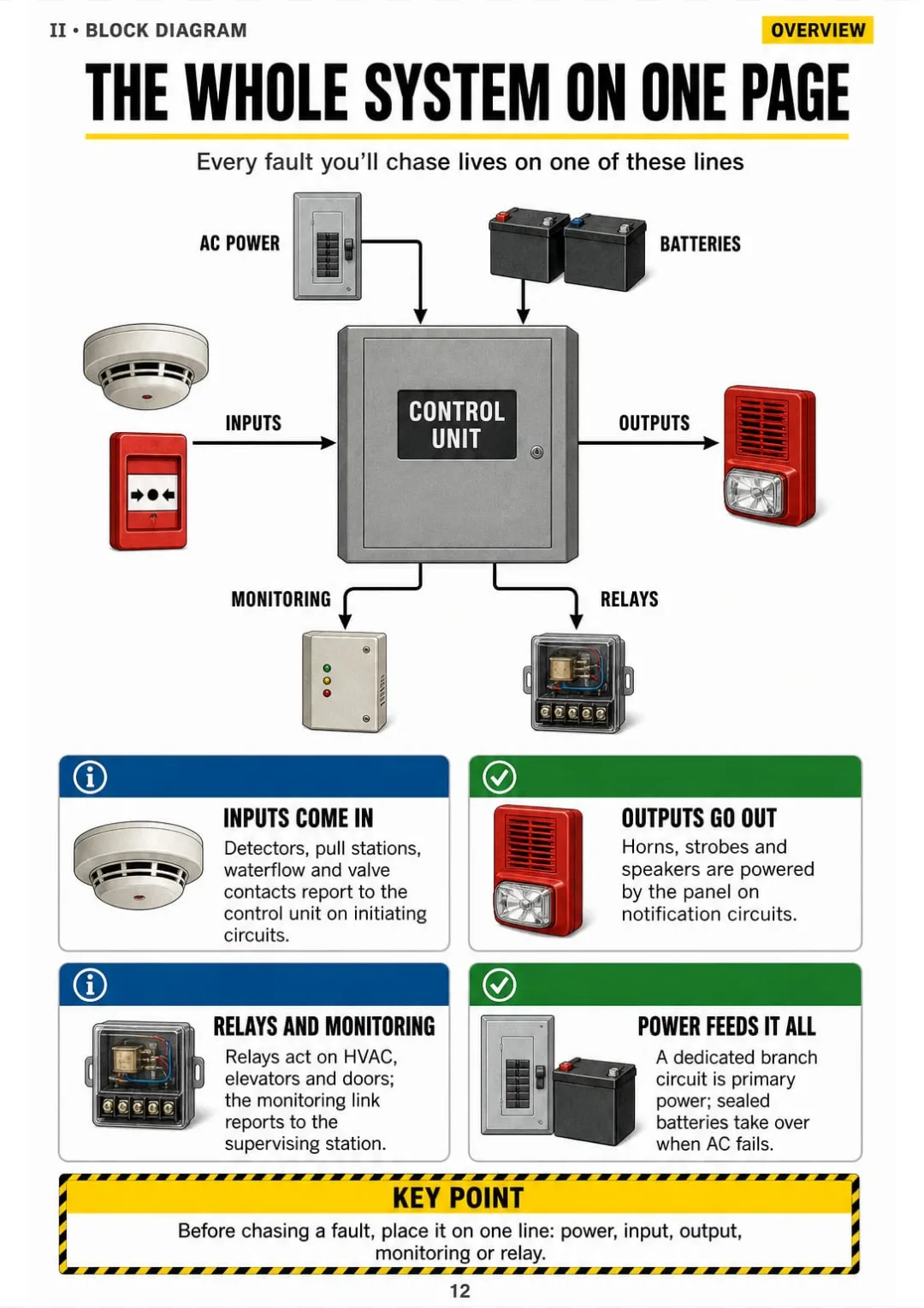
The whole system on one page, IDC, NAC and SLC, Class B and its end-of-line resistor, Class A and its return path, Class X and N, conventional vs. addressable, and riser diagrams.
Who to notify before you touch a wire, disabling outputs, powering down the right way, the meter on DC volts, ohms and milliamps, and when a megohmmeter is off limits.
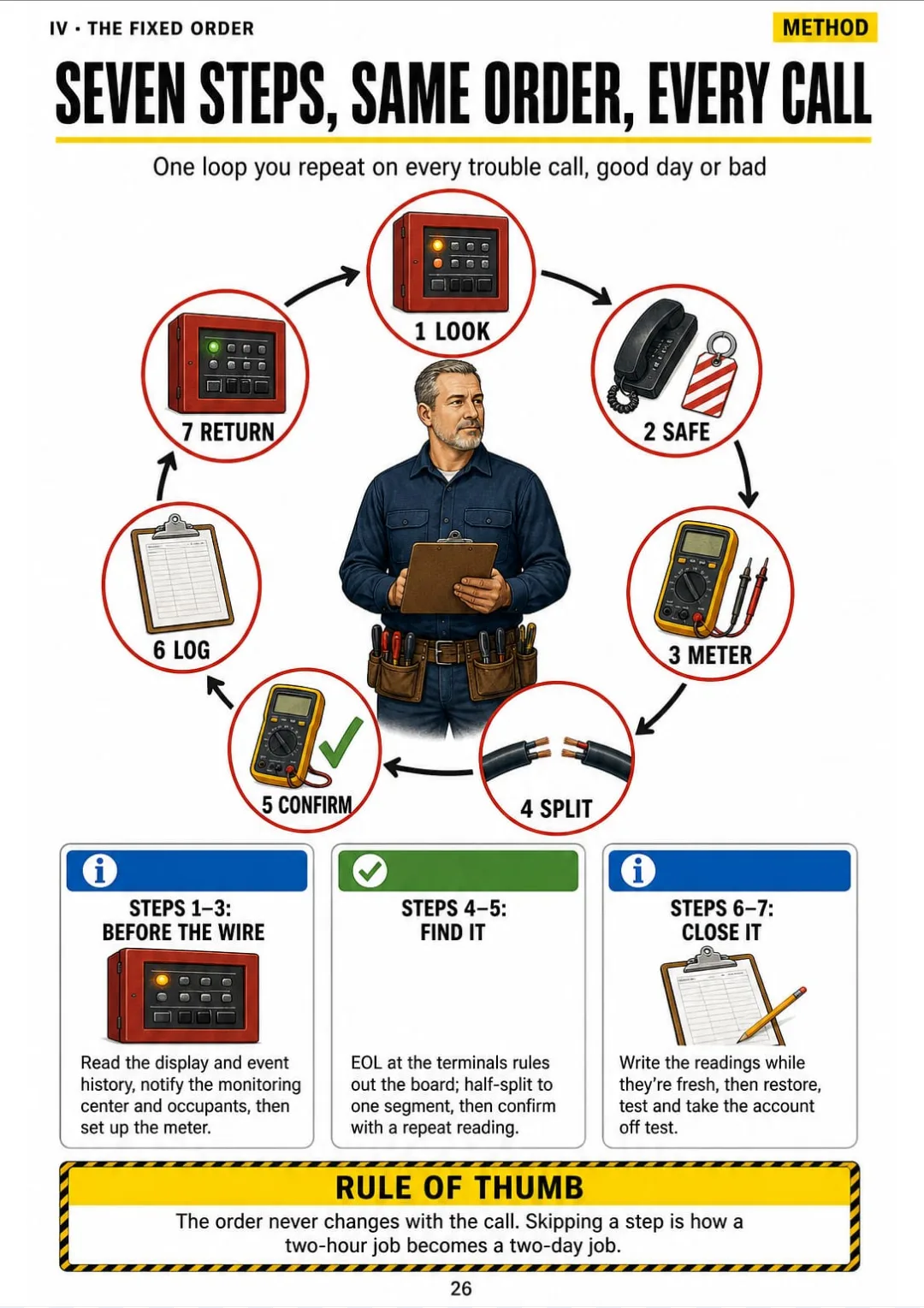
The seven steps on one page: look at the panel and the event history, make it safe, set up the meter, half-split (junction boxes first), confirm, log it and return to service. Plus how to make an intermittent fault show up.
You stop lifting wires at random: what a ground fault really is, why the panel can't say which circuit, lifting one at a time, each leg to ground with the reading to expect, half-splitting, the usual suspects and moisture faults.
Opens on a Class B IDC and how to find them, shorts that read as alarm or trouble, NAC polarity, a reversed device, T-taps, voltage drop and why the last strobes look dim.
How a loop talks, opens and shorts on an SLC, isolators, duplicate addresses, the five usual nuisance alarm causes, detector location, sensitivity testing and duct detectors.
AC loss and brownouts, the battery check with the meter, standby and alarm time, a worked battery calculation and trouble coming from the power supply.
The reading-to-fault table, the most frequent mistakes on a trouble call, panel messages by style, talking to the building owner and the seven-step checklist to print.
At the end of the book: Worked meter examples, a reading-to-fault table and a seven-step checklist to print.
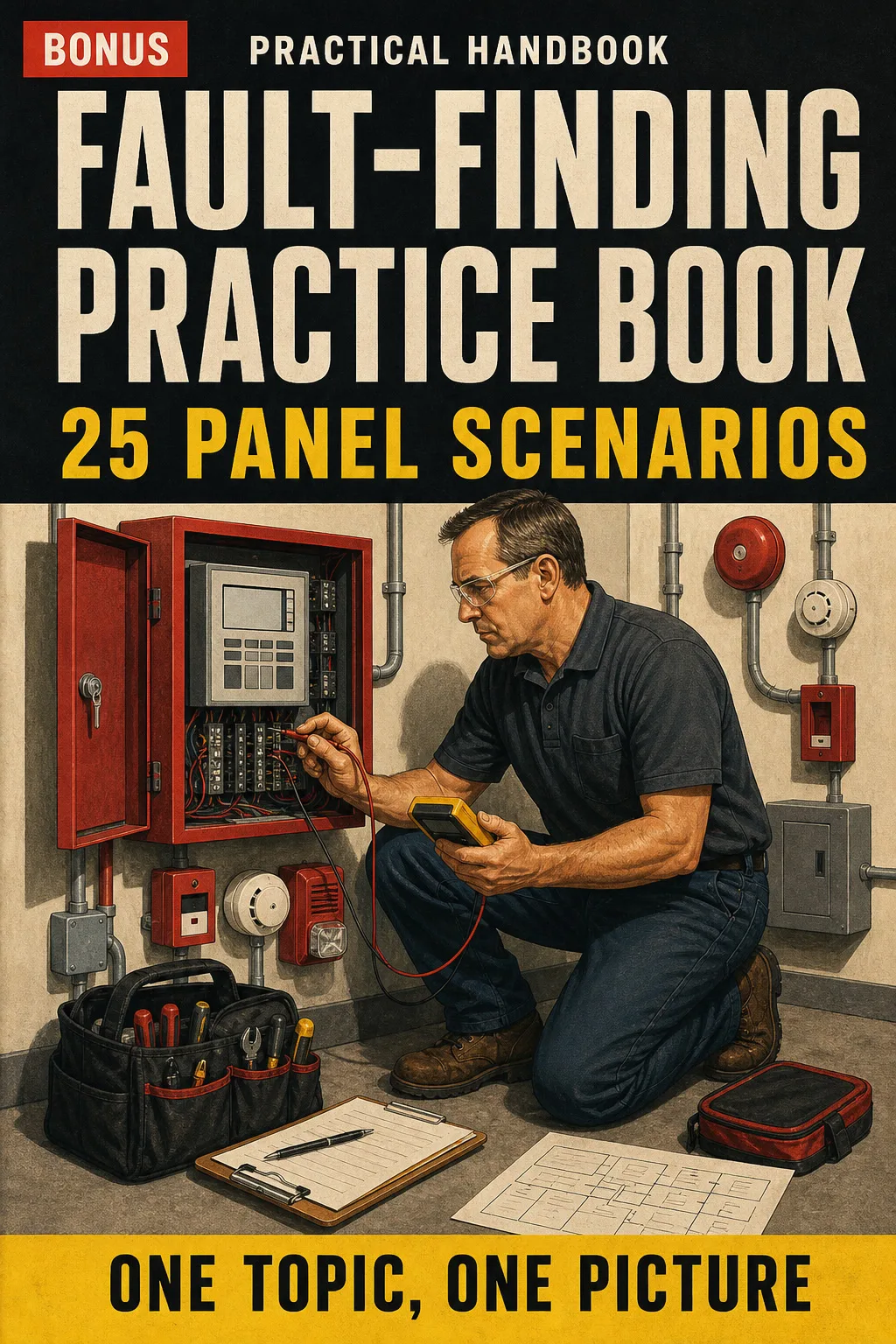
Work through real-world trouble calls on paper, from the panel message to the meter reading to the fix, so the method is second nature before you're standing at the panel.

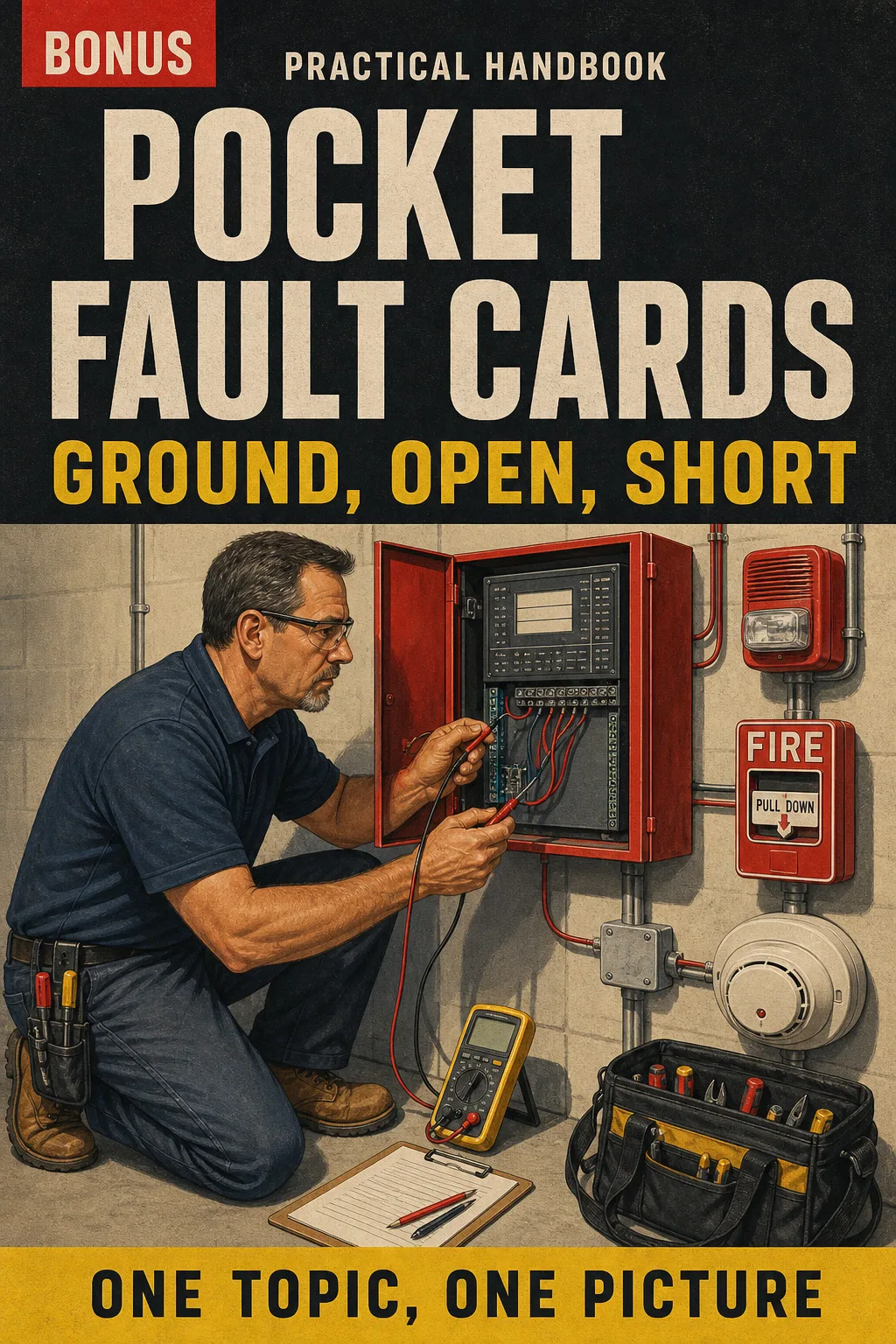
One printable card per fault with the symptom, the meter reading to expect and the next step, to keep in the truck and check at a glance.
📄 This is a digital PDF book sent to your email: nothing is printed or shipped.
PDF by email: We email you Fire Alarm Troubleshooting Illustrated as a PDF, together with the two free books. It's a single payment: no installments, no extra charges.
You get the whole system as a block diagram and one fixed order to follow, so you're not guessing which wire to lift first.
Alarm, supervisory and trouble stop being a mystery: each signal and each fault is drawn on the wiring, with the meter reading to expect.
You get the method in one place to keep in the truck, plus a checklist and fault logs to print and hand to a new tech.
📄 This is a digital PDF book sent to your email: nothing is printed or shipped.
Try Fire Alarm Troubleshooting Illustrated for 30 days, bonus books included.
We refund everything if the file won't open, if the book isn't what you see here, if you were charged twice or if the email doesn't arrive. Just email us.
You pay once. No subscriptions.
Yes. It isn't a beginner course: it's the troubleshooting method in one fixed order, drawn one topic per page, to check at the panel. It also works to train a new tech.
It's checked against NFPA 72 (2022 edition) and NEC Article 760. Each state and city adopts its own code edition, so check which one your AHJ enforces. Device-specific values (end-of-line resistors, batteries, intervals) are marked to verify against your panel manufacturer's manual and the code adopted where you work.
No. It's an independent illustrated book. It isn't published, approved or endorsed by NFPA or by any panel manufacturer.
No. It doesn't replace manufacturer training, licensing requirements or supervised field work. Any work on 120 V AC power is for qualified, authorized personnel only.
The method does. Meter readings, Class A and Class B circuits, ground faults, opens and shorts work the same way on conventional and addressable panels. What changes by manufacturer is the menus, the messages and the end-of-line values, so the book shows panel messages by style, not by brand, and marks what to check in your panel's manual.
The book and the 2 bonus books come as a PDF by email, to the address you enter at checkout.
No. It's a one-time payment.
Yes. The PDF is printable, so you can print the pages and the fault cards and keep them in the truck.
You have 30 days. We refund everything if the file won't open, if the book isn't what you see on this page, if you were charged twice or if the email doesn't arrive: just email us.
No more rereading the manual with nothing sticking.
Ground faults, opens and shorts: you see them drawn, and they make sense.
You walk up to the panel knowing where everything is.
Drawings make studying faster.
The book is right below.
One-time payment: US$ 27 · Guarantee: 30 days · PDF by email
YES, I WANT FIRE ALARM TROUBLESHOOTING ILLUSTRATED FOR US$ 27📄 This is a digital PDF book sent to your email: nothing is printed or shipped.